Is Your Western Business Mindset Clashing with the Japanese Style? 5 Surprising Cultural Gaps You Should Know Before Your Trip

Image source: Canva
The Japanese market represents a lucrative opportunity that populations globally dream to partake in and, given this opportunity, the last thing you would want is for your habitual business practices to create unexpected barriers. You may be confused walking into a meeting with a wide grin and enthusiastic energy, only to be met with a more serious, straight forward returning demeanor. The quick decision turnaround you may be expecting could set you up for disappointment as you find yourself waiting for final discernment.
Cultural disconnect during travelling is not limited to the language barrier, but a difference in historical, sociological, and philosophical identities.
Western countries, in their communication styles and business practices, have most prominent roots in Judeo-Christian individualism leading them to champion the idea that individual conscience is the ultimate moral authority. This creates a more individually focused society, producing a more entrepreneurial drive, meritocracy basis of individual performance, and economic freedom. This is also colored with the influence of Greco-Roman logic on Western society binding business practices with binary thinking (things are either right or wrong / it is either a win or a loss).
Alternatively, Japanese society has been historically influenced by Confucianism, creating more of a prioritization of social harmony within the workplace today. This is corroborated by an influence of Buddhism and Shintoism which values impermanence of self (less individualistic), connection between nature and business, and incorporating spiritual identity within every aspect of life.
5 Cultural Gaps Every Business Traveler Needs to Know:
Before diving into the full extent of these cultural differences, take a second to check out the primary ideas to keep in mind as you prepare for your trip, at a glance.
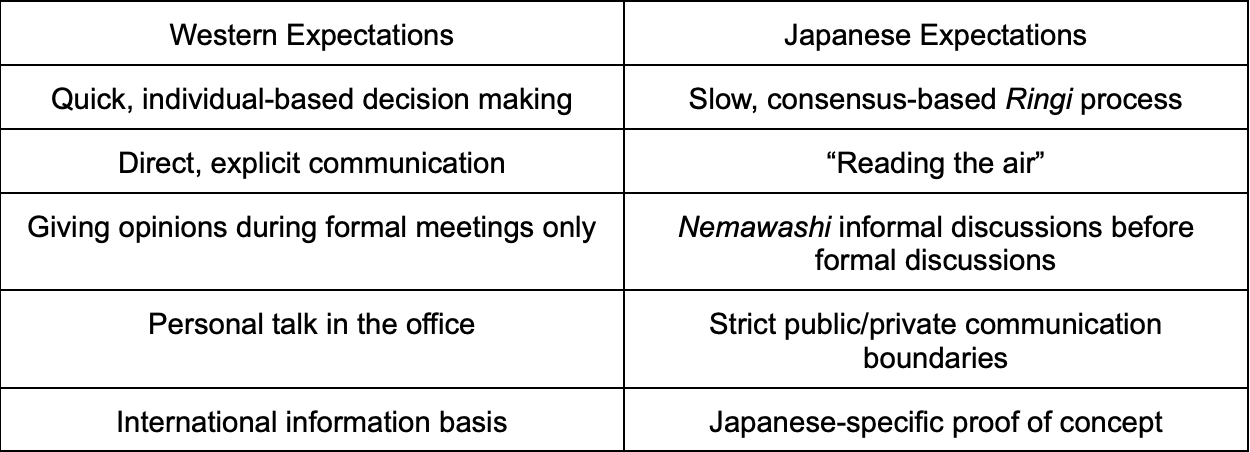
Image Source: TokudAw
We are happy to explore these gaps in depth, giving you and your team what you need to know to navigate the Japan business sphere with confidence and cultural awareness.
TokudAw provides quintessential knowledge for exploring key cultural gaps with the incorporation of this background context to help any entrepreneur or corporate partner overcome these barriers and build strong, meaningful business and personal connections in Japan.
Expectation of Immediate Response versus the True Consensus Process
In most Western business settings, there is an importance placed on speed, but not necessarily efficiency. Responses are timed: “We’ll get back to you by…”, as the goal is to make decisions as quickly as possible. Aristotelian philosophies of efficiency influence Western business settings to view time as valuable as money. This is one difference to be well aware of in Japan, however. The approach to decision making is different, and therefore requires different action and attitudes. Decision making is usually instead a team effort rather than an individual’s choice. This bottom-up decision making process is known as “Ringi” in Japanese corporate and government settings.
An employee drafts a proposal “ringisho” that is expected to be incredibly detailed, researched and to hold some kind of importance for the company.
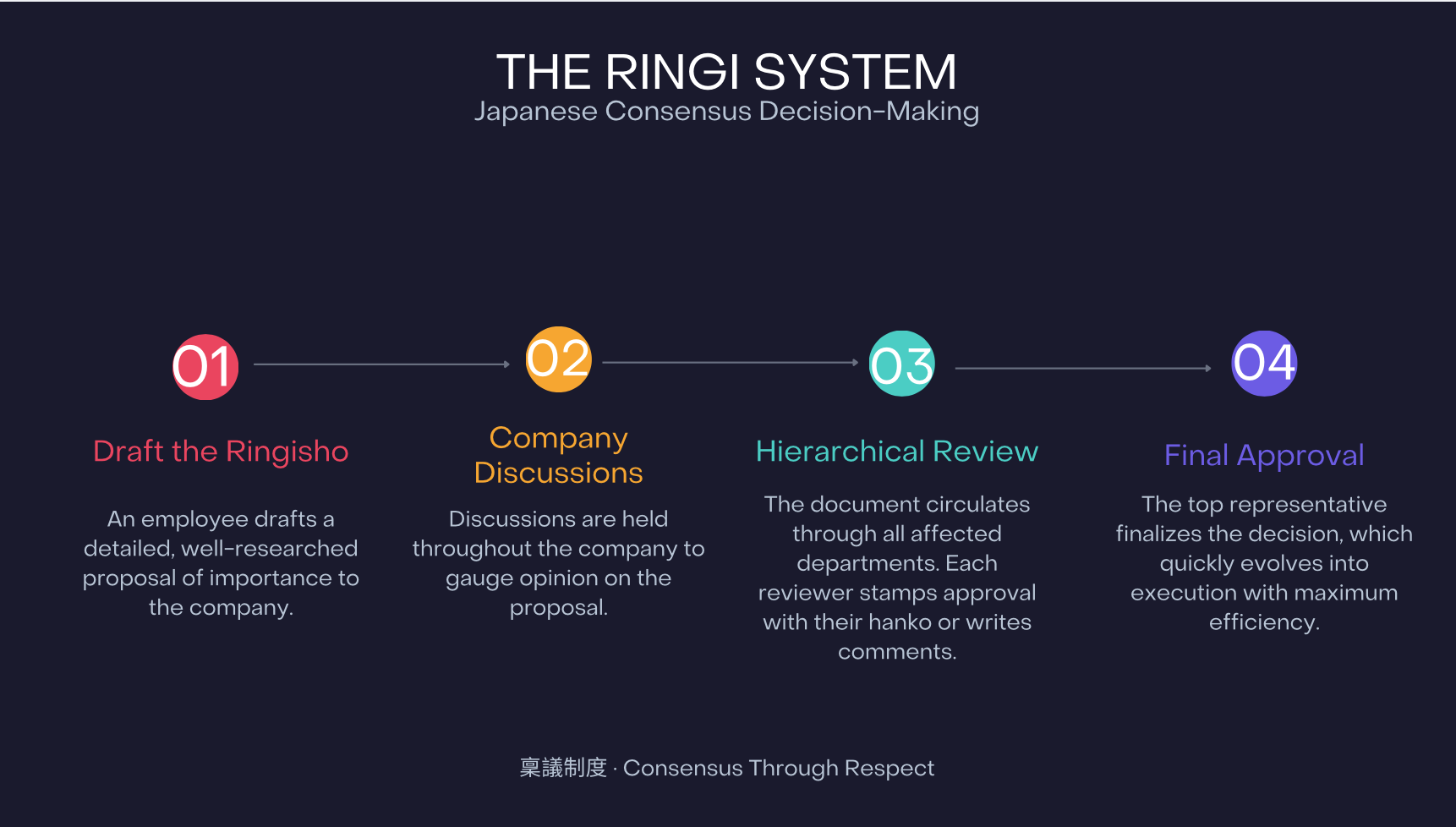
Image Source: TokudAw
Discussions are held throughout the company to gauge opinion
The document then circulates through all affected departments in a hierarchical order for review, feedback, and approval. Each reviewer stamps the document with approval “hanko” or writes comments in regards to their opinion of the proposal.
The decision is finally finalized by the top representative of the company which quickly evolves into the execution of the decision with maximum efficiency.
While it isn’t as swift of a process, it is not to be treated as inefficiency. It is treating every decision with the utmost care and consideration as every branch of the organization aligns in one direction to ensure the best decision possible. So try not to be alarmed or discouraged if you experience this kind of waiting that may seem unfamiliar and stressful. Proposals are not being brushed off, they are being carefully considered.
Speaking Your Mind versus Reading The Room
Western communication practices have roots in the Socratic tradition of direct dialogue. People are used to following the golden rules: “Communication is key”, “The truth will set you free”, and “You don’t know until you ask”. Japanese communication has alternative influences of Zen Buddhism which creates a society that values the space between words, the meaning within silence, and the energy between people. The golden ideology is known as “Kuuki wo Yomu” or “reading the air”. It is more than reading body language, it is reading the nuances of the environment and emotions of people around you. The idea stands to say that the ‘truth’ is not in what is explicitly stated, but in the underlying emotion charging the speech, the connotation. The hesitancy in an answer can explain what that person is trying to say.
While Westerners could view this Buddhist principle as evasive and avoiding confrontation, they could be missing the emotional intelligence and deeper personal connection between people using this communication style. If you are faced with feedback or communication that is frustrating or indirect in Japan, try recognizing these subtle cues in tone and emotion to understand the true direction of the conversation. Emphasis is placed on the harmony of the environment and community, it is important to consider the needs of everyone.
Our pertinent tip is to remain polite, respectful, and retain softness and malleability within your language; your adjustments will put you in a much better place for honest communication!
Individual versus Collective Opinion
As a Westerner, it is not uncommon to be asked by your supervisor “So, what do you think?” with the expectation of a thought-out, immediate, professional response. This actually comes from an intense history of the Protestant work ethic where individual contribution is what is merited over group developed results. This is primarily performed in official meetings and sometimes in front of other employees. With this background, there may be a culture shock when the real important discussions of company matters happen more-so behind the scenes in more sociable settings. It may be seen as “informal”, but it puts employees in a more comfortable position with an emphasis on collective opinion rather than individual.
The Confucian hierarchy becomes most visible in this process, as decisions are socialized over food or drinks, getting a general consensus of the stance of the entire group before formal decision making procedures. The formal meeting past this point is more so a formality to officially approve what has been previously discussed and agreed upon in these more comfortable settings.
A Westerner may find that not being asked their opinion in front of their boss puts them in a better social position within their daily role and come to like this dynamic. To better adapt to this cultural exchange, it can be helpful to engage in these side meetings with people to help determine the group’s stance and fine-tune your personal view to best benefit the official meeting with the supervisor.
It is pertinent to understand these inner workings within this hierarchy and methods of communication in Japanese business culture.
Small Talk versus Personal Connection
In the West, it is a growing norm to be open in discussing home life, free time activities, and politics within the workplace as a means of building rapport. There are blurred lines between the private and professional place in an effort to project your most authentic self in every section of life, not being “fake”. In Japan, there is a much stronger boundary between the public mask and the private face. Until an actual deep personal connection is formed between another person, communication is primarily done with “Tatemae” (socially acceptable behavior curated for being perceived publicly). Personal matters are seen as not necessarily taboo, but too intimate to be discussed in the workplace. As a Westerner, it would be best to avoid such topics in business settings and keep conversations limited to business-related topics and surface-level friendly topics.
What may be surprising to you, however, is that it is not unusual to be invited to visit a shrine or notice religious objects or symbols displayed in the workplace. Given a Western background, you may be used to secularism separating religion and business and be surprised by Japan’s Shinto adaptation of philosophy intertwining spiritual life and commerce.
It is best to be aware of appropriate workplace conversation, language, and behavior as well as sacred connection to religion within business life. However, do not let this become a barrier to you or cause you to be afraid to connect to people within your workplace. With these tips in mind, pre-travel research, and gentle adjustments to your communication style, you’ll be well on your way to making strong, professional, meaningful relationships in your Japanese workplace.
Universality versus Japanese Specificity
There is a priority of universal applicability and appeal within Western business values, the idea is that what will succeed in the West will succeed anywhere. There is an effort to remain objective, straight-forward, scientific, and profit driven with every business decision and product made.
Japan, however, remains largely contextual because their culture is so unique that specific environmental adjustment matters more than universality of application. The value is placed on localism and how well things can be implemented into their specific societal fabric. Proposals must be based on Japan and have Japanese statistics and evidence to back the success of a particular product or idea. For instance, a German case study seen as a “global” success in the West, wouldn’t be as relevant in Japan unless it applies to the Japanese expectations, behavior, and social structure. Therefore, if you are used to presenting to a Western audience, proposals, case studies, and products tested by the metrics of other Western nations are powerful evidence of your success.
In Japan, you will need to answer the all-important question of “Have you done this in Japan?” This could be surprising to Westerners who are reliant on the verification of international success. It is best to present the proof of concept within the scope of the Japanese market in order to demonstrate that you have local trust and presence with the knowledge to handle Japanese-specific issues. This is an opportunity to step up your game and meet people in the middle, working hard to bring your skills to the next level and expanding your range of success into different environments!
Your Bridge to the Japanese Business World is Shorter than You Think!
It is easy to be overwhelmed and frustrated by such philosophical differences that are new and rigid in nature, you can be scared of doing or saying the ‘wrong’ thing, but with the responsible acclimation of new ideas and behaviors, you can find yourself with a stronger mindset for having had this experience. It is more than adapting to a new role professionally, it is adapting an entirely new and unique worldview that spans all areas of your ever-changing life.
This blog provides the cultural and historical context to the more tangible tips and tricks to adapting to Japan supporting the emotional connections alongside the professional connections business travelers seek to make. Think of it less as ‘walking through a minefield’ and more like ‘walking through a garden and smelling the flowers’, you are learning as you go, adapting to the experience as you are sensing it
As a guide, TokudAw is always here for you with a multitude of Instagram, Website, loaded with tips, tricks, and anecdotes to refer to in your Japan travel experience!
TokudAw’s Business Services
Beyond transport, we support executives, directors, managers, corporate teams and any business traveler in between! Through our specialized B2B arms, we ensure efficient and logical coordination for every area of the journey through Japan.
Corporate Travel
Our Japan Corporate Travel provides logistical support for business delegation, VIP transport, corporate trip planning, and much more. Our clients have included international NGOs, government embassies, and Worldwide Olympic Partners. We offer:
VIP and Corporate Transport: Comfortable and high-spec vehicles equipped with professional drivers prepared for any range of passengers
Corporate Trip Planning: Logistical support ensuring that transportation will not be a stressor for your visit so you can focus on the things that matter.
Curated Experiences: Assistance with restaurant reservations, connections with interpreters and local businesses, and meeting location research
Corporate Responsibility: Consideration for multi-faith needs, disabilities, dietary needs and restrictions, as well as ESG alignment
We’ve got it covered!
Business Service, Consulting and Market Entry
Our Japan Business Service offers active bilingual consulting for foreign business travelers. Most interestingly, our Adaptor service helps you seamlessly bridge cultural gaps, build relationships with Japanese partners, and provide hands-on assistance to place your business in the line of success.
We offer:
Market Sourcing and Support: Identifying and vetting local suppliers, assisting with pitch and presentation materials to best connect with Japanese audiences
Cultural Interpreters: Teaching unspoken expectations and social guidelines to ensure smooth relations with Japanese partners
Network Building: Introducing your business to vetted professionals to cement your place in the Japanese market
How We Serve Emerging Industries:
Not only has TokudAw had a flawless history of bridging connections in the Japanese business world in the past, we are also looking towards the success in the future. TokudAw already has extensive experience supporting clients within emerging and booming industries.
This includes:
Cryptocurrency and Fintech: Japan is positioning itself as a global hub for digital assets and blockchain innovation, TokudAw is fully involved with this process
Aerospace Technology: Japan’s growing space programs and research, such as JAXA, creates a need for international collaboration, which we fully support.
Healthcare: Japan, as it faces a new aging population dynamic over recent years, creates an avenue for medical research and innovation in eldercare.
Government and Diplomacy: Not only is Japan the holder of the world’s 4th largest economy, it is also a G7 member, major decisions are being made every day.
If you’re a corporate executive that stresses planning delegations, team travel, or the exploration of new markets, you will be relieved to know that TokudAw provides a solution to every problem!
Why Traveling with Japan Private Drivers Makes a Difference
For a busy, professional, and still-adjusting traveler, it can be time consuming and distracting to navigate Japan’s complex public transport on a tight schedule. TokudAw provides an excellent private driver experience, allowing for your travel time to serve as additional productive or restful time for you. This equates to more time preparing for meetings, taking calls, or ruminating on your ideas before your next professional encounter.
This entails:
Convenience: From your first door to your last, TokudAw assists you and your belongings through the busy city, eliminating any possibility of getting lost or having your items misplaced.
Professionalism: Our chauffeurs are punctual, polite, and understanding, considering that they are accustomed to the expectations of the Japanese business world.
Flexibility: Our drivers adapt to your schedule, allowing for a long meeting or an early presentation, as time is not as predictable in such important settings.
The TokudAw Difference
Traditional travel agencies tend to operate more rigidly, booking tickets and stepping back for you to navigate the experience on your own. TokudAw operates past arranging transport, every business travel experience is orchestrated with seamless, efficient, and understanding adjustment to every individual traveler’s needs. You are given guidance in every area of your travel, ensuring you move through Japan as successfully as possible.
FAQ: Navigating Japanese Business Culture
What is the best way to show my diligence and dedication in Japanese work culture?
It is best to be overly prepared for every meeting and professional encounter, provide thorough details and documentation, and remain punctual at all times.
What does “we’ll consider it” really mean?
Pay attention to the tone and nuances of body language when hearing statements like this. Excessive hesitation could signal that this means “no”, but it is important to remain patient and positive for the process of final decision making to receive a definitive answer.
Will I face alienation or dismissal as a foreigner in Japanese workplaces?
Overt discrimination in Japanese workplaces is legally prohibited, although overall experience can vary widely depending on the company. However, to best avoid workplace isolation in an unfamiliar environment, engage in informal meetings, do your research, and remain polite in all interactions with colleagues and supervisors. The expectation is ultimately that everyone will adapt to Japanese business customs.
Is asking questions directly in moments of confusion seen as rude?
Of course not, this just requires some careful phrasing! When asking a question, it is best to ask clarifying, respectful questions that are not too convoluted. As always, be mindful of the rank of the people in the conversation, the culture is primarily hierarchical.
Is it okay to talk about my family and background in the workplace?
While it is safer to stick to ‘neutral’ topics like the weather with people you do not know that well, it is not taboo to discuss personal topics after deeper relationships are developed over time.
