How is Japan for Neurodivergent Travellers? (2026 Guide)
If you've been reading about Japan and quietly wondering whether your brain can handle the crowds, the noise, and the unfamiliar food, you're not alone.
Many neurodivergent travelers share the same hesitation, and most of them come back saying Japan was easier than expected.
What ND travellers say about Japan
Neurodivergent travelers consistently describe Japan as one of the easiest countries they've visited because of four things: quiet public trains, real personal space even in crowds, clearly visible social rules, and almost no expectation of small talk.
● Trains are quiet: People don't talk on them. One first-time visitor described stepping onto a Tokyo train, registering the silence, and thinking, "finally."
● Personal space is real: Even in crowded areas, people work hard not to bump into you or touch you; something many neurodivergent travellers say they didn't realize was wearing them down at home until they spent a week somewhere it wasn't happening.
● The rules are visible: You can usually figure out what's expected by watching what others do, then doing it. Train platforms have footprints painted on them showing exactly where to stand, and people actually stand on them. Lines also form without anyone announcing the line.
● Small talk barely exists: You can move through entire days without anyone expecting you to be friendly.
A few things the glossy guides don't tell you
Now let’s look at some warnings that come from neurodivergent people who've actually lived in Japan:
1. The rule-following is real, but so is "reading the room"
Japan is rule-driven and you're still expected to read situations and pick up on unspoken expectations. People are polite to your face.
If you get a rule wrong, no one will tell you — they'll just quietly note it. Neurodivergent travelers used to direct cultures sometimes find this exhausting differently.
Disclosing ASD isn't usually helpful
Neurodivergence isn't widely discussed or understood in Japan the way it is in parts of the West. Travellers who've spent significant time in East Asia generally suggest you don't need to explain yourself because being a foreigner already explains anything "off."
Most people will read any unusual behaviour as cultural rather than clinical.
Tokyo specifically is a sensory event
Multiple long-term residents have said the same thing: if crowds are hard for you, the three big cities, Tokyo, Kyoto, and Osaka, are the hardest parts of Japan. Smaller cities and rural areas are calm.
So go anywhere besides those three, and you'll find beauty, kindness, and adventure with a fraction of the crowd.
Medication rules are strict
Some common ADHD medications are completely banned in Japan even with a valid prescription. Others are allowed only with paperwork submitted in advance. Sort this out weeks before your trip.
10 travel tips for neurodivergent travellers to Japan
Here are some tips to help neurodivergent travel groups who’re planning to visit Japan like you:
Tip 1: Heat your bento, don't suffer through it cold
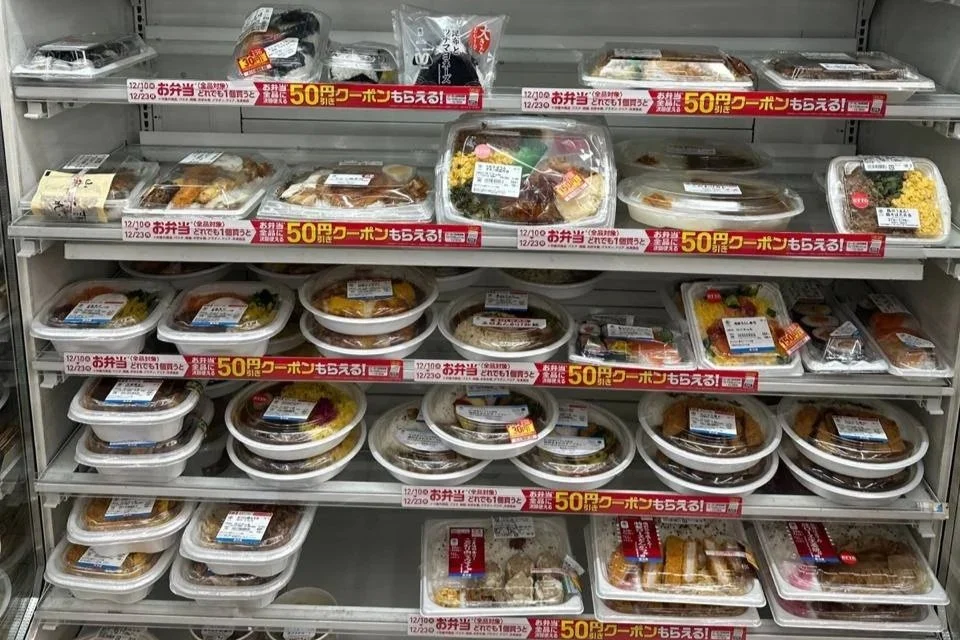
Bentos available at convenience stores.
At major Shinkansen stations, look for self-heating bento boxes called kanetsu bento, which heat up in five minutes after you pull a string on the side. Anywhere else, every 7-Eleven, Lawson, and FamilyMart will microwave your food at the counter when you say "atatamete kudasai."
This is important because Japanese cuisine often serves rice and proteins at room temperature, and that's a real problem if cold or lukewarm food bothers you.
Tip 2: For texture, stick to Western-style bakeries
For familiar textures, visit department-store food halls (depachika) at Isetan, Mitsukoshi, or Takashimaya, or chain bakeries like Vie de France. Both have Western-style cakes, puddings, and croissants with clear labelling.
Many Japanese buns and pastries contain anko, a sweet red bean paste with a thick, slightly grainy texture you can't always spot from the outside. And as someone who is not used to it may find anko unpleasant.
Tip 3: Carry a printed allergy card, and be specific
Carry a printed card in Japanese with your allergies and hand it to the staff when you sit down. For genuine allergies, add the line 少量でも食べられません ("I cannot eat even a small amount") to remove any ambiguity, since Japanese kitchens sometimes interpret "no X" as "a small amount is acceptable."
Japanese restaurants rarely offer menu substitutions, and dedicated allergy menus are even less common.
Tip 4: For dimmer evenings, walk three streets back from the station
Walk three or four streets back from the busy stations and the brightness drops off almost entirely. Residential neighborhoods like Yanaka in Tokyo and the back lanes of Gion in Kyoto stay calm and dim well into the evening.
The areas around major stations like Shinjuku, Shibuya, Akihabara, and Dotonbori are the brightest parts of any Japanese city at night.
Neurodivergent travelers who've lived in Japan tend to figure this out on their own and drift toward the quieter areas naturally. But you don't have to skip the bright districts. Just know that the calmer version of the same city is always close by, and you can go there whenever you've had enough.
Tip 5: Plan for the 5 pm chime
Every day at 4:30 or 5 p.m., speakers across Japan play a short melody called the goji no chaimu. It's a daily test of the country's disaster-prevention loudspeaker system, not a warning. Ask your hotel front desk for the exact local time on check-in so it doesn't scare you in a quiet temple or park.
If you don't know it's coming, the first time you hear it in a quiet temple garden or a small residential street can feel jarring. The sound carries, and depending on where you're standing, it can come from several directions at once.
Tip 6: Avoid parks at midday in July and August
Visit parks like Yoyogi, Ueno, and large temple grounds in the early morning before the heat builds. Or plan your trip for late September through October when the cicadas are gone, and the country feels noticeably quieter.
Japanese summer cicadas produce a wall of sound that's hard to prepare for if you've never experienced it. It's a constant, layered drone that fills the entire space around you, and on a hot afternoon, it can be the loudest thing you'll hear all day.
Tip 7: Walk to the end of the platform
Avoid Japanese train rush hours from 7:30 to 9:30 a.m. and 5 to 7 p.m. In addition, board the first or last carriage rather than the middle ones because they are closest to the station stairs, so they’re always packed.
If trains still feel like too much after trying both methods, look into a private tour. Some travel agencies like TokudAw offer dedicated cars with drivers and itineraries built around sensory needs, which is worth the cost for travelers who want to see Japan without the transit stress.
Tip 8: Map the smoking corners before you turn them
Japanese cities contain outdoor smoking to small marked zones near station exits and specific intersections. Use Google Street View ahead of time to spot these smoking corners on your route.
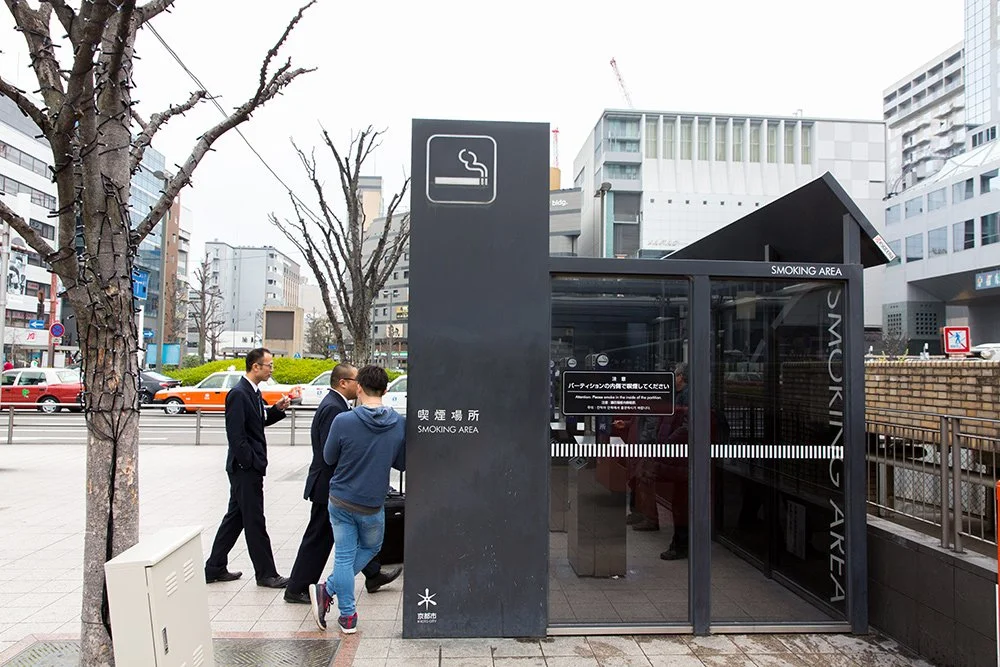
Smoking Areas, like the above, are commonly seen in Japan.
Photo Source: Kyoto Travel
Since Japan handles smoking differently from most countries, once you know the pattern, it's easy to avoid.
Note: Indoor smoking in restaurants and cafés has been banned since April 2020, so you can walk into almost any interior without worrying about it.
Tip 9: Use coffee chains as your indoor benches
Public benches are rare in Japanese cities, so buy a small drink at chains like Doutor or Komeda's Coffee to rent a quiet seat for an hour. Department stores like Isetan, Mitsukoshi, and Takashimaya also have free rest areas on their upper floors.
Tip 10: Skip the headline sights at peak times
Visit Japan's famous attractions in the first hour after opening, or trade them for smaller cities like Kanazawa, Takamatsu, Matsumoto, and Onomichi where the crowds thin out.
Famous places in Japan are famous for good reason, and they're worth seeing. The crowds are the problem, not the sights. For neurodivergent travelers, the sensory load of peak-hour tourism can ruin a place before you've actually taken it in.
But there are two ways around this, and both work.
● Go early: Most major attractions stay calm for the first hour after opening. Kenrokuen Garden in Kanazawa is nearly empty at 7 a.m. and packed with tour buses by 10. Fushimi Inari Shrine in Kyoto is quiet at sunrise and overwhelming by mid-morning. Same place, completely different experience.
● Go smaller: Kanazawa, Takamatsu, Matsumoto, and Onomichi offer the same depth of culture and food as Tokyo, Kyoto, and Osaka, with a fraction of the people.
In our experience, neurodivergent travelers consistently rate these smaller cities and rural towns higher than the big three for actually enjoying the trip.
Plan a sensory-friendly trip with TokudAw
Japan rewards travelers who go in with a plan. The country itself does a lot of the work, with quiet trains, clean spaces, and predictable systems, but the difference between a good trip and an overwhelming one usually comes down to pacing, timing, and the small choices made before you leave.
That's the part TokudAw handles.
We build private-car itineraries one at a time, around the things that actually matter for neurodivergent travelers:
● how many hours of activity feel right in a day
● which sights are worth the crowds and which ones to skip
● where to eat without texture surprises
● when to slow down
If you're planning a trip and want to talk through what would work for you, we'd be glad to help.
FAQs
1. What is a neurodivergent traveler?
A neurodivergent traveler is someone whose brain processes the world differently than the typical traveler, often because of autism, ADHD, sensory processing differences, or related conditions. They usually need more control over pacing, noise, food, and crowds to enjoy a trip.
2. Is Japan autism-friendly?
Japan is one of the more autism-friendly countries to travel in, mainly because of quiet trains, clear social rules, and strong respect for personal space. Awareness of autism as a clinical concept is lower than in the West, but daily life is structured in ways that work well for autistic travelers.
3. What's the best time of year to visit Japan for neurodivergent travelers?
Late September through October is the easiest stretch. The cicadas are gone, the weather is mild, and the country feels noticeably quieter. Avoid Golden Week (late April to early May), Obon (mid-August), and the New Year holidays, when domestic travel spikes and crowds are at their worst.
4. Are Japanese trains overwhelming for neurodivergent travelers?
They can be at peak times. Rush hours run from 7:30 to 9:30 a.m. and from 5 to 7 p.m. Outside those windows, trains are quiet.
5. Can I bring my ADHD medication to Japan?
Some common ADHD medications, like Adderall and Vyvanse, are completely banned in Japan, even with a valid prescription. Others, like Ritalin and Concerta, require a Yakkan Shoumei import certificate submitted weeks in advance. Check Japan's Ministry of Health website before you book, not after.
6. Should I disclose my autism or ADHD when traveling in Japan?
Usually no. Neurodivergence isn't widely discussed in Japan the way it is in parts of the West, and most people will read any unusual behaviour as cultural rather than clinical. Being a foreigner already explains anything "off," so you rarely need to explain yourself further.
7. How do I get a TSA autism card, and does Japan have something similar?
In the US, the TSA Cares program lets you request screening assistance by calling 72 hours before your flight, and you can carry a TSA notification card to discreetly inform officers. Japan doesn't have a direct equivalent, but Haneda and Narita airports both offer assistance services if you request them in advance.