From Gardens to Baths: The Scientist’s Guide to help you get over jet lag when arriving in Japan
In my last post, we discussed how to use nutrition as a metabolic anchor to beat jet lag. But your body has another set of sensors—photoreceptors in your eyes and mechanoreceptors in your muscles—that are just as critical for "re-entraining" your circadian rhythm.
To truly master the transition to Japan time, you need to strategically manage your exposure to the environment. Here is the scientific blueprint for your first 48 hours in Tokyo.
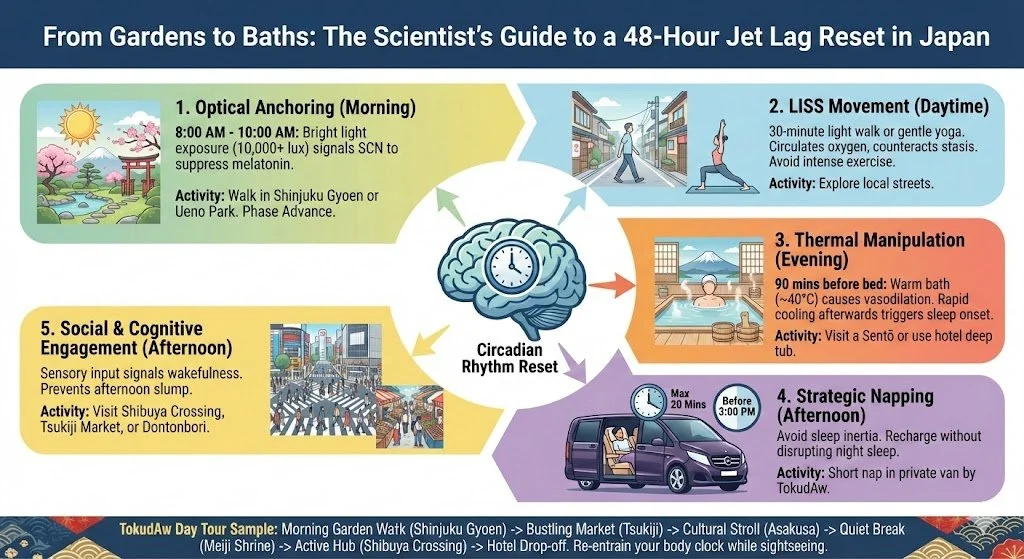
Some ways we can help you combat jet-lag whilst doing some sightseeing around Japan.
1. The Power of "Optical Anchoring"
Light is the most potent Zeitgeber (time-giver). When light hits your retina, it sends a signal to the Suprachiasmatic Nucleus (SCN) to suppress melatonin and boost cortisol.
The Science: To "phase advance" (shift your clock earlier for Japan), you need bright light exposure in the local morning.
The Activity: On your first morning, head to a Japanese garden like Shinjuku Gyoen or Ueno Park between 8:00 AM and 10:00 AM. Walking outdoors provides roughly 10,000 to 100,000 lux of light, significantly more than any indoor light, effectively "resetting" your brain’s master clock. Getting adequate exposure to sunlight each day is crucial for keeping your melatonin production in sync with your sleep/wake cycles.
2. Low-Intensity Steady State (LISS) Movement
While it’s tempting to hit the hotel gym for a heavy lifting session, science suggests a different approach.
The Science: Intense exercise at the "wrong" biological time can cause a spike in core body temperature that interferes with your later sleep cycle. However, light movement helps circulate oxygen and counteracts the "stasis" of a 12-hour flight.
The Activity: Opt for a 30-minute light walk or a gentle yoga session. Japan is perfect for this—exploring a local neighborhood on foot is the best low-intensity exercise to keep you awake without overstressing your nervous system.
3. Thermal Manipulation: The Sentō Strategy
Your body’s core temperature naturally drops in the evening to prepare for sleep. You can "hack" this process using a traditional Japanese practice.
The Science: Research shows that an evening warm bath (around 40°C) causes vasodilation. When you exit the bath, your core temperature drops rapidly—a biological trigger for deep sleep onset.
The Activity: Visit a local Sentō (public bath) or use your hotel's deep soaking tub 90 minutes before bed. This will help align your body temperature with Japan’s night cycle, even if your brain is still buzzing.
4. Strategic Napping: The "20-Minute Rule"
The "afternoon slump" in Japan will feel like a wall of bricks. How you handle it determines your recovery speed.
The Science: Napping longer than 30 minutes can lead to "sleep inertia" and prevent you from falling asleep at the local 10:00 PM.
The Activity: If you must nap, try to keep it within 20 minutes before 3:00 PM. The private vans by TokudAw provides the perfect safe space for you to take a short nap, to help get over jet-lag, and also to recharge before your next activity.
5. Social Interaction and Cognitive Engagement
Our social environment also helps regulate our rhythms. Staying isolated in a dark hotel room is the fastest way to stay jet-lagged.
The Science: Cognitive engagement and social cues signal to the brain that "this is a period of wakefulness."
The Activity: Visit a bustling area like Shibuya Crossing in Tokyo or Dontonbori in Osaka. Local markets- Tsukiji Market, Toyosu Market in Tokyo, and Nishiki Markets in Kyoto and Kuromon Market in Osaka are great to visit in the afternoon. The sensory input-sounds, sights, and social interaction-forces your brain to stay in an "active" state, preventing your internal clock from slipping back into a sleep phase.
A TokudAw day tour to help you combat jet lag whilst helping you acheive sightseeing may look like: Early morning visit to a beautiful Japanese Garden like Shinjuku Gyoen, Rikugien or Hama-rikyu Gardens. Next we will stiumulate the senses by visiting the bustling Tsukiji Market, the must visit Asakusa Nakamise Street, a quiet break at Meiji Shrine followed by Harajuku and Shibuya Crossing before we drop you off at the hotel.
All TokudAw tours are private and created around your interests, and your pace. Contact us here to find out more!