How to Prepare for the Weather in Japan and Why It Matters for Your Trip
Image source: Canva
Japan is known for its remarkable cyclical seasonal beauty: cherry blossoms in the spring, beautiful leaves in autumn, powdery snow slopes in winter, and lively fireworks in the summer. Each season brings its own magic that travelers can’t seem to get enough of. However, there are some things that travelers may not be considering. Japan’s weather, while beautiful, can also be intense.
Summers are famously hot and humid.
Winters bring heavy snowfall and strong winds.
Rainy and typhoon seasons can disrupt plans with flooding risks.
The difference between a trip filled with pleasant memories and one where you feel drained and overwhelmed comes down to one factor: preparation. The weather may not be in our control, but preparation sure is! Understanding Japan’s climate, packing the right things, and building flexibility into your itinerary can transform your experience for the better.
We’re here to help! This guide will walk you through what to expect in each season, how to pack smart, and why traveling with TokudAw is the best way to stay comfortable and relaxed and make the most of your journey, come rain or shine.
Japan’s Seasons and Their Challenges at a Glance:
Before we dive into the details, here is a quick overview of Japan’s seasons and how travelers can prepare for their dream trip.
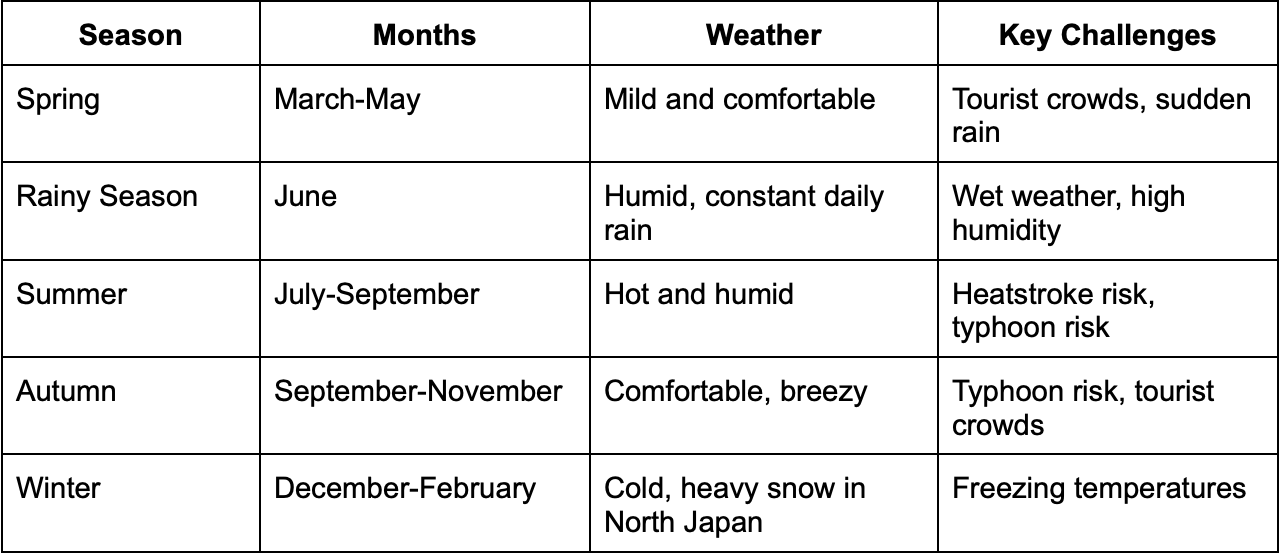
We will explore each season and what it means for travelers in depth, offering practical tips and showing you how TokudAw helps you travel comfortably no matter the weather!
Spring: Comfort, but Crowds
Spring is one of Japan’s most beloved seasons for visitors. Temperatures are not just tolerable, but comfortable, making it the most ideal time of year for exploring cities, temples, and gardens. The world-renowned cherry blossom trees that sweep from south to north start blooming in January in Okinawa and end their season in May in Hokkaido are certainly the star attraction in Japan’s spring season.
What to Expect:
Temperatures: Pleasant during the day and mildly chilly after dusk
Crowds: Peak tourist season, high crowds and prices are expected
Weather: Generally dry, occasional showers
Our Packing Tips:
Layers: Temperatures can shift throughout the day, we advise bringing a light jacket and waterproof accessories
Comfortable shoes: Many outside activities require lots of walking!
Umbrella: Bringing a compact UV/rain umbrella protects you from both the sun and rain
Pro Tip: Be flexible with cherry blossom visits!
Cherry blossoms in Japan are famously unpredictable. In Tokyo especially, the main season is typically late March to early April, but blooms can appear as early as mid-February in some regions and as late as May in others. Frequent spring showers can also mean blossoms only last for a couple of days. The ‘blooming calendars’ are really just predictions. The most accurate information will be available the week of your travels.
This is why the key is to be flexible, both in what flowers you want to see and where.
Booking a car with TokudAw ensures you are able to travel to where the blossoms are blooming at the time of your visit.
Having fixed plans like train travel makes it harder to adapt to each season’s changes. If you arrive too early or late for cherry blossoms in one area, plum blossoms (February) and wisteria tunnels (late April) are equally beautiful sights!
Rainy Season: Cool Temperatures, but Frequent Rain
Japan’s rainy season typically runs from June through July, but don’t let the rain scare you off! Temperatures during this time are actually quite comfortable compared to the sweltering summer that follows.
However, there is a silver lining: June is the perfect time to see hydrangeas, which are abundant because of the rain and represent longevity and gratitude in Japanese culture.
What to Expect:
Showers: It rains very often at this time, however, there are dry windows in between
Humidity: The air feels damp and heavy
Atmosphere: Rainfall adds a special beauty to temples and sacred sites
Our Packing Tips:
Lightweight jacket: A must-have for staying dry without overheating
Waterproof shoes: Don’t ruin your nice shoes!
Plastic Bags: To protect your electronics and valuables
Pro Tip: Don’t run, embrace the rain!
The rainy season offers a unique, atmospheric perspective on Japan. Visit traditionally sacred areas like Ise-Shime National Park or Yoshino-Kumano National Park, the rain adds to the mysterious ambiance! Don’t forget to look for the beautiful hydrangeas blooming everywhere!
Summer: Sunny Weather, but Heatstroke Risk
This is the season that tends to concern tourists the most. Summer in Japan is hot, humid, and unwavering. Temperatures can exceed 100 degrees fahrenheit with humidity levels consistently over 65%. Recently, heatwaves have caused serious health risks, even fatalities. The Japanese Embassy has even issued warnings for travelers to take precautions. Preparation is very important for travelers during this time, but it certainly isn’t impossible!
What to Expect:
Temperatures: High temperatures occur especially in Tokyo, Kyoto, and Osaka
Humidity: Sweat doesn’t evaporate as easily, increasing the risk of heatstroke
Typhoons: Risk peaks around August, watch for heavy rain and winds
A Note on Accommodations:
Most Japanese hotels do not have swimming pools, which many travelers are surprised to find out. When booking hotels in the countryside or mountain areas, be aware that some older ryokans (Japanese-style inns) may not have air conditioning.
Where to Go:
Summer is the perfect time to visit rural and Northern Japan to escape the urban heat. Even in the mountains and Northern Japan, temperatures may continue to reach over 90 degrees fahrenheit with high humidity levels. Regions like Okutama on the outskirts of Tokyo are where locals go to partake in water activities like rafting or kayaking. These towns offer things tourists want to experience along with the ability to cool off!
Our Packing Tips:
Reusable water bottle: Stay hydrated and can refill at many places around Japan
Portable fan: Having a fan in combination with cooling wipes can be a lifesaver
Sunscreen: Essential for protecting your skin against the intense sun.
Electrolyte drinks: Drink Pocari Sweat or Aquarius, the Japanese version of Gatorade. These drinks are designed to keep hydration and important mineral levels up.
Pro Tip: Plan around the heat!
Avoid outdoor activities during peak heat hours. Plan your day around the heat by seeking air-conditioned spaces, starting early, and watching for heatstroke symptoms. Remember, building AC isn’t as strong in Japan as it is in the West, and you will be walking much more than you would at home. Plan accordingly!
Autumn: Beautiful Foliage, but Typhoon Risk
Autumn offers some of the most comfortable weather of the year, it is cool and dry. The autumn foliage colors make for beautiful pictures and visual appeasement. The leaves begin to change in September in Hokkaido and end in December in the South. This is the ideal time for travelers to do some outdoor exploration!
What to Expect:
Temperatures: Pleasant day temperatures and cool evenings
Clear Skies: Beautiful views and gorgeous backgrounds for scenic walks
Typhoons: Becomes a concern in September, especially in southern and coastal areas
Our Packing Tips:
Layers: Evenings can be cool, so be prepared for a slight breeze
Waterproof Jackets: For occasional rain or typhoons
Comfortable Shoes: For exploring outdoor areas
Pro Tip: Fall colors peak late in the season!
Fall colors peak in late November and December for Tokyo and Kyoto, not September or October like it might be in other areas of the world. Many people are thrown off that they won’t see fall colors if they come to Tokyo then. They can if they travel up north, though! A trip timed for around Thanksgiving is a great time to see colors for much of the lower regions of Honshu.
Timing is everything!
Winter: Seasonal Fun, but Heavy Snow
Winter in Japan is utterly gorgeous. Hokkaido and the Japanese Alps transform into winter wonderlands with deep and crisp snowfall known as “Japow”. Major cities like Tokyo, Kyoto, and Osaka experience cooler temperatures with occasional light snow. The cold is usually dry, making it more manageable for travelers than the humid summer heat.
What to Expect:
Temperature: Temperatures range from -10 degrees celsius or colder in Hokkaido to 12 degrees celsius in Tokyo and Kyoto
Snow: Heavy in northern and mountainous regions, rare in major cities
Crowds: Low crowd counts outside of ski resorts, accommodation price drop
Our Packing Tips:
Layers: Thermal base layers, insulating middle layers, and waterproof outer layers
Heat Packs and Accessories: Packs available at convenience stores and work well with accompanying gloves, hats, and socks
Winter Boots: Waterproof and non-slip soles for icy conditions
Pro Tip: This is the best time to visit Mount Fuji!
Winter is the best time to see Mount Fuji, the clear, dry air offers the most beautiful views of Japan’s iconic peak. For snow lovers, the best Japow falls late January to mid-February usually. If you are planning to visit the snowy regions, check transportation updates in advance. While trains run reliably year-round, local buses and flights may be delayed or suspended in heavy snow. A private car with TokudAw ensures you can travel comfortably, even in winter conditions.
The TokudAw Difference
Here at TokudAw, we understand that weather can be a concern for travelers. We’re here to ease your mind. This is why our itineraries are designed with flexibility in mind.
Our private, self-paced itineraries make sure that rain or shine, our private vehicles provide a comfortable, climate-controlled space where your family can relax and be yourselves between destinations. No rushing to catch a bus in the rain or navigating hectic train stations in rising heat, just a safe, comfortable place where you can feel at peace.
If a typhoon is approaching, we can adjust your itinerary to account for both safety and enjoyment. Switching to indoor activities like museums, cultural workshops, or shopping experiences can still provide the authentic Japanese experience you desire.
Your comfort and safety is our priority.
Our vehicles feature low steps, wheelchair ramps, and generous space for everyone to travel comfortably, in any kind of weather. And of course, our drivers and guides are very familiar with regional weather patterns and can recommend the best activities for any forecast.
FAQ: Weather Preparation in Japan
What is the best time of year to visit Japan?
It depends entirely on what you want your trip to look like. Spring (March-May) and autumn (September-November) offer the most comfortable temperatures and stunning natural scenery, but they are also peak tourist seasons with higher prices and crowds.
How hot does Japan get in the summer season?
Summer temperatures have lately been exceeding 35 degrees celcius with humidity levels over 65%. Therefore, heat in Japan can certainly be intense because concrete and buildings trap the heat. So, please take this into consideration as heatstroke is a serious risk. With precautions, summer trips to Japan can definitely still be enjoyable!
How can I prepare for Japan’s rainy season?
The rainy season typically runs from early June to mid-July. Days are permeated with humid air alongside frequent daily showers, but there are dry windows in which the weather clears up. We recommend waterproof shoes, although booking a car with TokudAw will also keep your feet dry!
What should I pack for a winter trip to Japan?
Layers are definitely essential for a winter trip in Japan. We recommend packing thermal base layers, a warm mid-layer, and waterproof outer layers. The more accessories, the better: gloves, hats, scarves, etc. If you plan to visit snowy regions like the mountains in North Japan, we recommend bringing waterproof winter boots with good traction.
Should I be worried about typhoon risk in Japan?
Don’t worry, with general caution and planning, you can still have a great time in Japan in any season! Typhoon season peaks in August and September, especially in southern regions like Okinawa, Kyushu, and Shikoku. Travelers should monitor weather updates, avoid outdoor activities during severe storms, and have flexible plans. In most cases, typhoons pass quickly and tours resume soon after.
How can TokudAw help me travel comfortably in any season?
TokudAw offers private, self-paced itineraries, comfortable vehicles with climate control, and flexible scheduling. If the weather changes, we can adapt your plans, switching to indoor activities or adjusting the pace to keep everyone safe and comfortable. We can also adjust your itinerary to follow the cherry blossoms or autumn colors as they bloom and change!
