
Japanese Hospitality: How Omiyari, Omotenashi, and Ganbarimasu Creates the Perfect Travel Experience
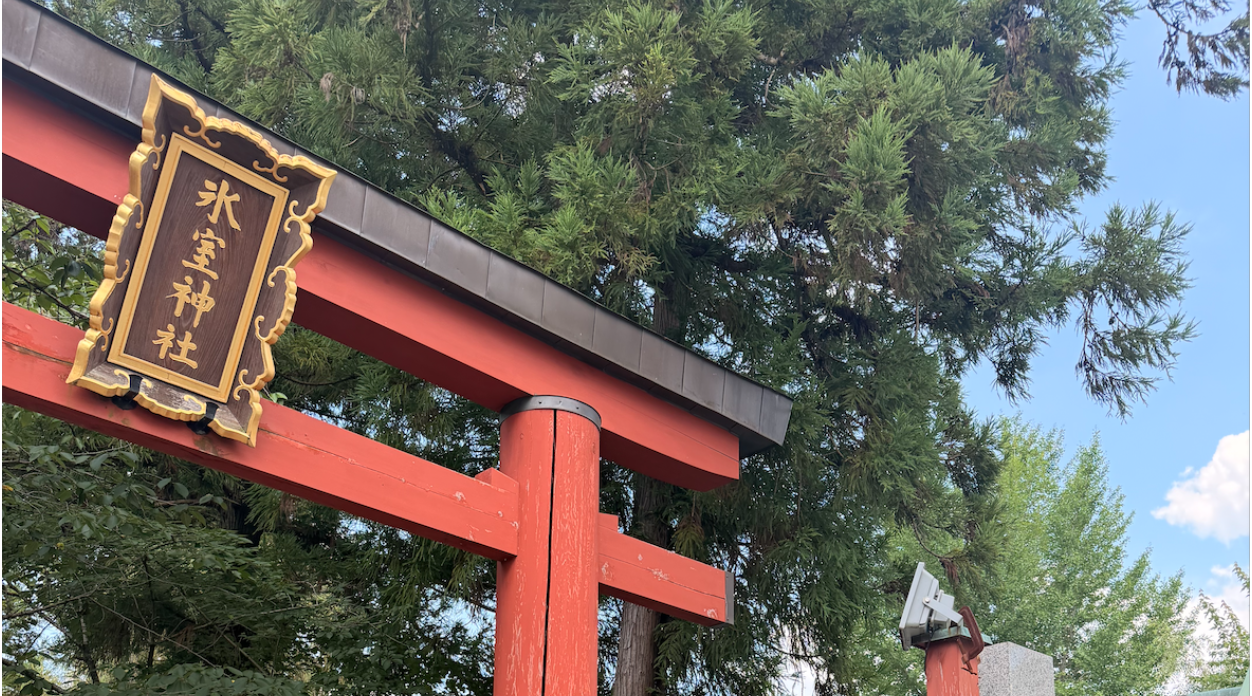
When you arrive in Japan, there is a difference in the air that you will feel immediately. The taxi driver greets you with a smile on their face and the doors open and close without anyone even having to touch them. The hotel staff supplies you with more than you will need for the duration of your stay with someone always present to assist you with any question you may have. The restaurant server offers you a menu in your language and is patient with you as you select your choice.
There is an immense energy of community that you may not have experienced previously, a connection between the entirety of Japanese society. In a way, as a tourist, this may feel like the performance of routine service in which you are only experiencing because you exist as a guest in this place. However, this is more than service, this is a shared philosophy of human connection rooted in four profound concepts: omiyari, omotenashi, ganbarimasu, and yorisou. These are just a few of the many principles that make up the ethical framework that transforms the human network of Japan into a world of love, care, and respect.
At a Glance: The Four Principles of Japanese Hospitality
Before we explore each philosophical idea in depth, here is a concise overview of the four principles that make travel in Japan, and with TokudAw, a truly transformative experience.
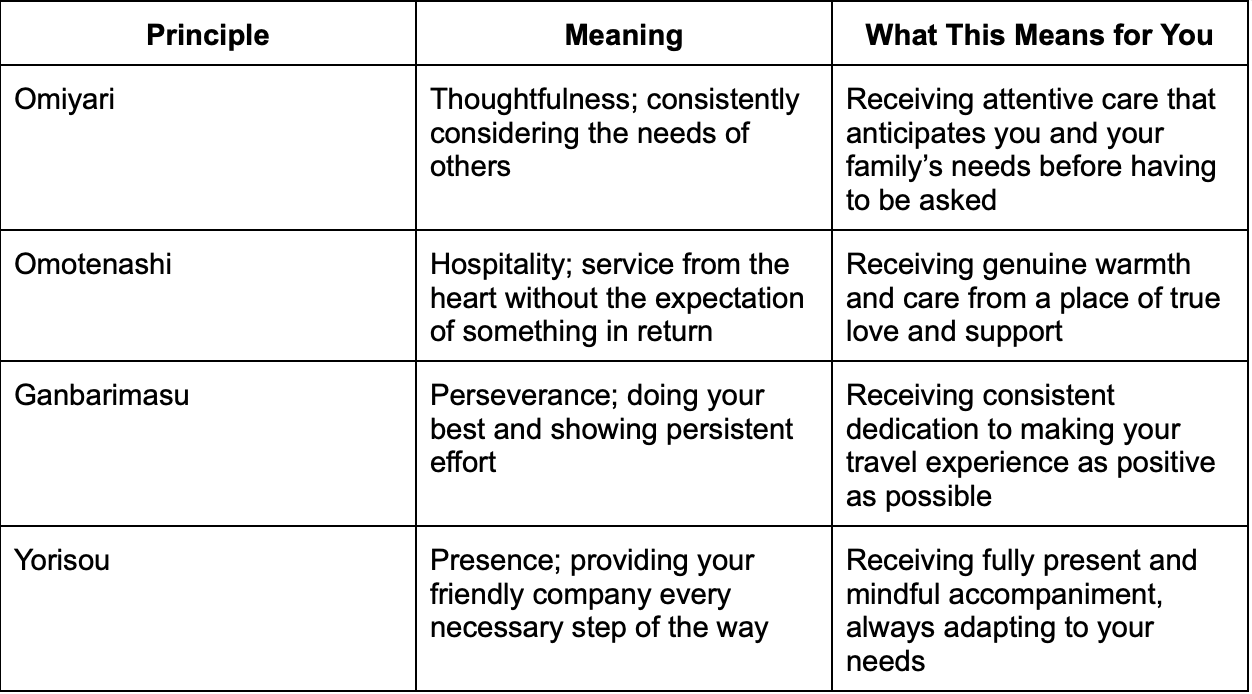
As we move through this article, we will explore each of these principles in depth, showing you how they create a travel experience that changes not only your Japan trip, but your life perspective for years to come.
Omiyari Thoughtfulness

Origins:
Omiyari is often translated as “thoughtfulness” or “empathy”, but this is thought to be an oversimplification of this concept. It is the utmost act of compassion and consideration, putting yourself in another’s shoes and acting on that understanding in a way that best benefits that person. Considering another person to this extent involves doing whatever you anticipate would make someone else’s life easier or more enjoyable.
This concept has ancient roots in samurai culture as a matter of life or death. Warriors would grow facial hair before battle so that even in defeat they would not embarrass their opponent by being mistaken for a child or woman (resulting in the ultimate dishonor). This was considered as an act of omiyari, profound thoughtfulness, where even the most brutal and violent interactions were conducted with dignity and respect as a baseline.
Since these times, omiyari has evolved from the battlefield to everyday life, presenting itself in both small and large ways. It could be as small as picking up a sleeping child from their stroller and finding a quiet, flat surface for them to sleep or a tour guide slowing down for the grandfather in the group who is struggling to keep up.
Omiyari in TokudAw:
Here at TokudAw, omiyari means anticipating your family’s needs and meeting them even before they are expressed. Our itineraries are built around your pace, priorities, and practices, resulting in a different product package for every family. We foresee and cater to the little things, providing children’s car seats and high chairs, wheelchair ramps, and the quiet space in our private vehicles available to you at any time where you can decompress after a busy traveling day.
We apply omiyari especially to our business customers by regularly tailoring offerings to the specific goals of each traveler. Whether our travelers are a family seeking educational experiences, a corporate client with a tight schedule, or a multi-generational group with varying needs, we adapt our services to fit their objectives. This could be designing a STEAM-focused itinerary for your children, arranging private meetings for business travelers, or incorporating extra time for grandparents to rest in between activities. It is all part of our commitment to thoughtful, personalized service.
Omotenashi Hospitality
Origins:
Omotenashi is among the most famous of Japan’s hospitality philosophies, as it is the most powerful act of “selfless hospitality” expressed through service that extends directly from the heart, expecting nothing in return.
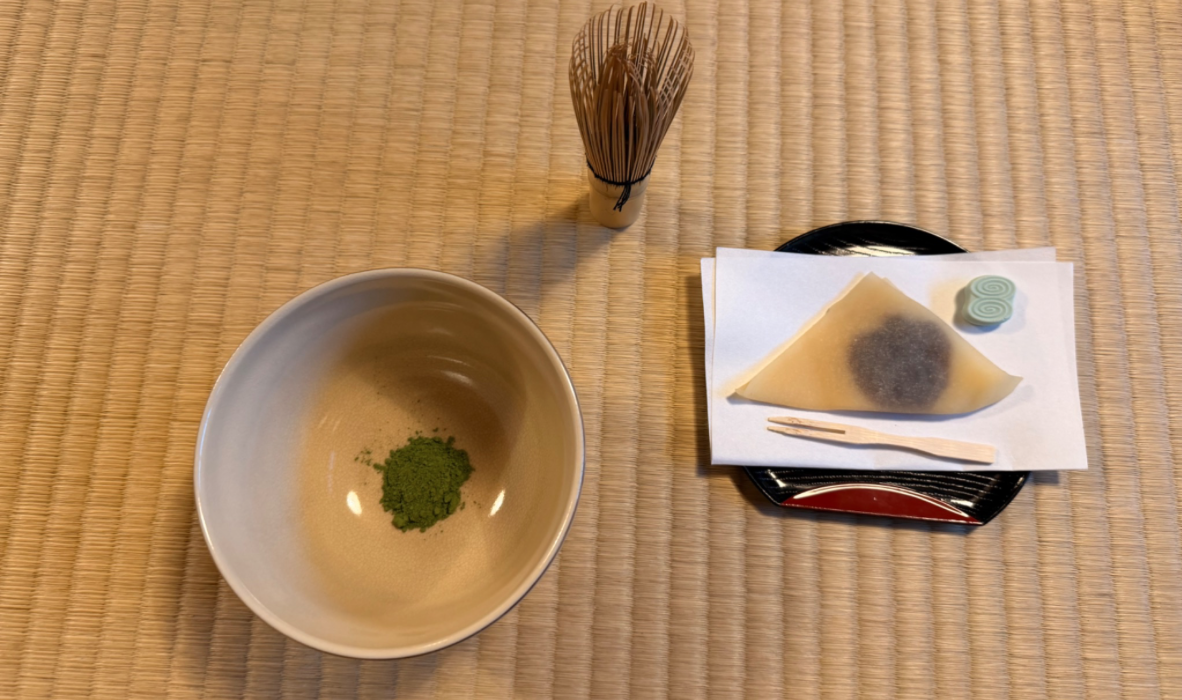
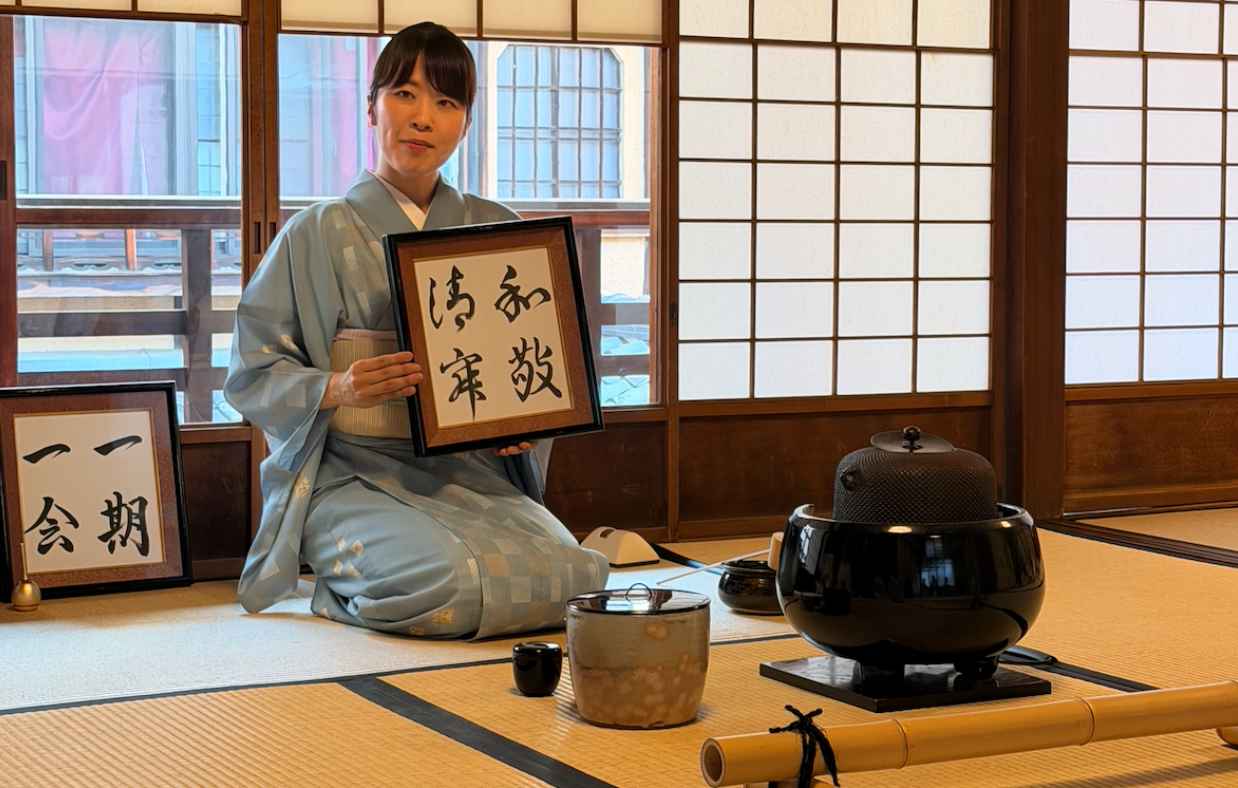
The practice of omotenashi originated in the Japanese tea ceremony traditions in the 1500s developed by legendary tea master Sen no Rikyū. In a tea ceremony, the host will remain actively aware of every single detail contributing to the guest experience. The temperature of the water, the material of the utensils, the placement of the flowers are all carefully considered and curated. Another tea ceremony philosophy that contributes to the omotenashi of Japan is the concept of Ichigo-Ichie. Ichigo-Ichie expresses the theory of “one time, one meeting”. This Japanese idiom originated in the tea ceremony traditions of the 16th century, later popularized in the 19th century specifically in the context of tea ceremonies. This philosophy emphasizes the importance of valuing every moment in our lives, because every encounter is unique and will never be repeated again in exactly the same way. With this background, selfless hospitality will continue to be performed with the seriousness of the fact that you will only have one opportunity to make the most beneficial difference in the lives of your guests.
This is an attempt to amend the trap travelers fall into trying to maximize every moment of their vacation. They think “this trip is once in a lifetime, I have to make the most of it”. However, going about that with back-to-back activities, rushing through shrines and temples, and blindly trampling through public transit to get from place to place makes for a trip where you have seen everything, but have experienced nothing. You come home with photos that are not attached to memories, and a completely checked off list that you haven’t learned anything from.
“Omote” translates to “public face” or the general portrayal of one’s self to the outside world.
“Nashi” translates to “nothing”
In combination, this word comes to mean serving with no pretense or hiding behind a facade, providing service that is genuine and an extension of one’s true self. This is not reserved for the most luxurious of environments, like most people would be accustomed to. Omotenashi is everywhere in Japan, embedded into every moment of service you receive. There is a scientific reason omotenashi provides such a pleasant feeling for both the giver and the receiver: when people perform acts of kindness, they experience a release of dopamine and endorphins that boosts self esteem, purpose, and identity. These feelings ripple outward, creating ‘pay it forward’, no thoughtful and genuine gestures and relationships, contributing to a more cohesive social unit.
Omotenashi in TokudAw:
Omotenashi is the backbone of TokudAw’s service philosophy. Our team serves with genuine warmth and care, not because it is a requirement of the service, but because it is a way of life that we wish to extend to you. Our drivers wait for you with no rushing or pressure, our guides offer cultural insight to help you connect with Japan on a deeper level, and our interpreters make this new world understandable for you.
“Omotenashi is not about impressing the guest. It is about making them feel truly welcomed, truly cared for, truly at home.”
One of the ways we apply omotenashi is through our in-transit cultural activities. Traveling as a family can feel long and can lead to restlessness and frustration. Therefore, to make every moment of your journey with TokudAw memorable, we plan activities and games relevant to any season. For example, making paper snowflakes or learning about winter festivals like Setsubun in the winter. These activities are not about ‘passing the time’, it is about helping the journey become a part of the experience.
Ganbarimasu Perseverance
Origins:
Ganbarimasu loosely translates to “I will do my best” or “I will put in my best effort”. This idea extends to an entire philosophical perspective in which a person commits to persevere through giving your all to any challenge. Linguistically, ganbarimasu is a volitional form, expressing the will of the speaker. It is impossible to be said passively or half-heartedly. In Japan, ganbarimasu is everywhere, equating to a motivated and successful nation in aspects both in and outside of profound thought. Here, craftsmen, tea makers, artists and citizens perfect their art over decades. This is the very spirit that rebuilt Japan in the past century and continues to drive innovation today.
Ganbarimasu in TokudAw:
At TokudAw, ganbarimasu means we never give up on your experience. This means that if plans change, something goes wrong, and if needs grow specific, we stop at nothing to make it happen. We are committed to doing our best for you by any means necessary. Our multilingual support team is available throughout your journey to answer questions, solve problems, and do what we can to ensure everything runs smoothly. We are especially responsive with providing quotes, consistent communication, and honest guidance through every facet of your travel planning process. Every member of your family deserves a safe and comfortable journey, this equates to every member of your family deserving a company like TokudAw who is especially dedicated to every need.
Yorisou Presence
Origins:
Yorisou is one of the more complex and beautiful concepts that remains powerful and prevalent in Japan. It means “to nestle” or “to walk alongside someone”, it is the act of being present with someone, adapting to their pace, and supporting them without judgment. Yorisou is not about someone in front leading or someone behind following, it is about people being truly present with one another.
The parent kneeling down to your eye level to listen more closely.
The friend sitting in silence and holding you in their arms when you need comfort.
The travel guide adapting to your needs and preferences when you are in an unfamiliar place.
In our modern world, speed and efficiency is demanded of everyone, creating a detached environment from ourselves and each other in the pursuit of greater ambitions. Yorisou is a radical act of presence. It is the recognition that the journey and the feelings this brings you matters just as much as the destination. It is the understanding that true connection comes not from rushing through life but from walking through it together. Japanese hospitality uses this mindset to make sure guests never feel alone when navigating through a new environment.
Yorisou in TokudAw:
Yorisou is at the heart of TokudAw’s approach to travel. Our itineraries are not prepackaged to be one-size-fits-all. They are built around your pace, interests, and unique needs. Our private vehicles provide a quiet and safe space where guests can relax, connect, and be themselves in those precious moments between dream destinations. Our drivers and guides provide more than just basic service, they embody Japanese hospitality in every way, being true present companions on your journey, walking alongside you every step of the way.
Here at TokudAw, we believe that the best trips don’t just move you from place to place, they move you closer to understanding yourself, others, and your environment; this is the essence of yorisou.
How TokudAw Incorporates the Four Principles in your Journey
If you are still having trouble visualizing how these four principles come together in a real travel experience, allow us to help you imagine your family’s journey with TokudAw:
Before your trip: Our team practices omiyari by anticipating your needs. We ask about your interests, ideal pace, and accessibility requirements. We ask about the age of your children, mobility of your grandparents, and dietary needs of everyone present. These kinds of considerations allow us to plan your itinerary with thoughtfulness and care.
During your trip: Our team embodies ganbarimasu by adapting whenever plans change and fixing whatever goes wrong. We always do our best to ensure your experience is everything you dreamed it to be. When you arrive, our drivers and guides welcome you with omotenashi. They serve from the heart for the sole desire to see you and your family happy. We adjust the temperature in the vehicle, offer water and snacks, and do everything we can to make sure every private car travel ride is comfortable. You are not treated as mere customers, but as valued and loved guests.
During transit (the special touch): Our team practices omotenashi by planning seasonal cultural activities and games for the car! Transit with family, especially young children, can prove to be trying. TokudAw sets the scene for a pleasant car ride that both passes quickly and engages everyone with activities relevant to the season.
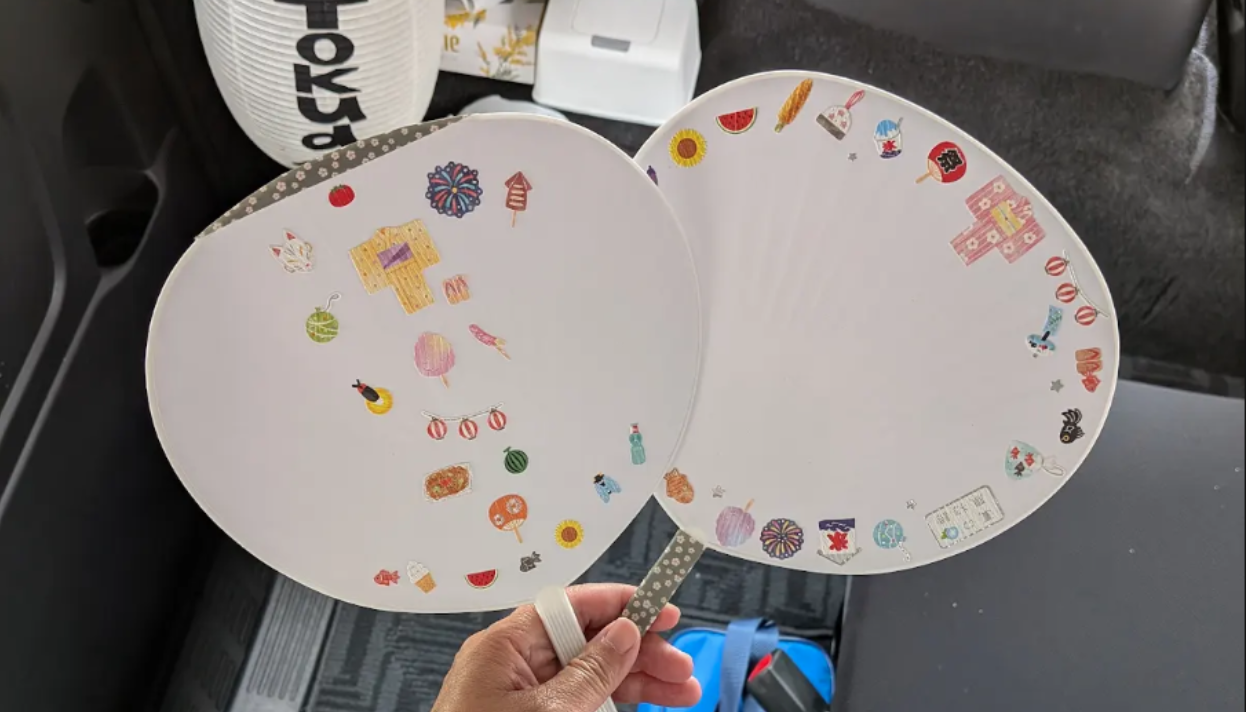
For example: you and your family could learn how to make a traditional Uchiwa fan, decorate it together, and use it to stay cool when you get to your destination! We might even share stories about the origins of seasonal festivals, teach simple origami, or play trivia about the destinations planned for the day!
This is omotenashi in action, we anticipate that your family may need entertainment and connection during transit, and provide it with intention.
After your trip: You will have memories of how our team practiced yorisou. We walk alongside your family from start to finish being fully present with you, without rushing you or pressuring you in any direction. Just being there for you.
The Philosophy of TokudAw
TokudAw was founded on the belief that travel should be about meaningful connections between people, cultures, and environments. Our mission is to make the seemingly overwhelming Japanese experience more manageable to explore for multigenerational families, business travelers or anyone who values thought-provoking, meaningful trips. Our team is built on a foundation of care, respect, and cultural fluency. We believe in clear communication, thoughtful guidance, and true commitment to doing our best in every interaction with guests. We serve clients with journeys that go beyond sightseeing to spark meaningful exchanges.
If you are ready to experience Japan through the lens of these four profound principles, let TokudAw help you design a journey that embodies omiyari, omotenashi, ganbarimasu, and yorisou.
Contact us today to start planning your family’s transformative journey to Japan.
FAQ: Understanding Japanese Hospitality Philosophy
What is omiyari and why is it important for travelers?
Omiyari means thoughtfulness. It means imagining the needs of others and acting on that understanding. For travelers, it means experiencing care that anticipates your needs before you even realize you have them.
What is ganbarimasu and why is it important for travelers?
Ganbarimasu means “I will do my best” or “I will put in my best effort”. It reflects the Japanese spirit of perseverance and dedication to seeing things through. It means that travelers will experience care that doesn’t waver in the face of changed plans or bad weather, it means having a team that works to provide the best experience possible regardless of the obstacles.
What is yorisou and why is it important for travelers?
Yorisou means to walk alongside someone, adapting to their pace and needs. For travelers, this means having a guide that is truly present with you without rushing or pushing you.
What is omotenashi and how is it different from ‘regular’ hospitality?
Omotenashi is selfless hospitality from the heart, expecting nothing in return. Unlike transactional service, it is about genuinely caring for the guest’s well-being.
How does TokudAw incorporate these philosophies?
TokudAw embodies all four principles through thoughtful planning (omiyari), genuine care (omotenashi), dedication to your experience (ganbarimasu), and personalized, adaptive service (yorisou).
What makes Japanese hospitality so special and worth experiencing?
Japanese hospitality is rooted in a deep cultural tradition of respect, empathy, and selfless care. It is not performative, it is a genuine way of being that has been passed down through generations.
