
A guide to the haunted side of Japan with Yokai and Japanese folklore.
Learn what they are, where find them throughout Japan and discover powerful life lessons by exploring their hidden world.
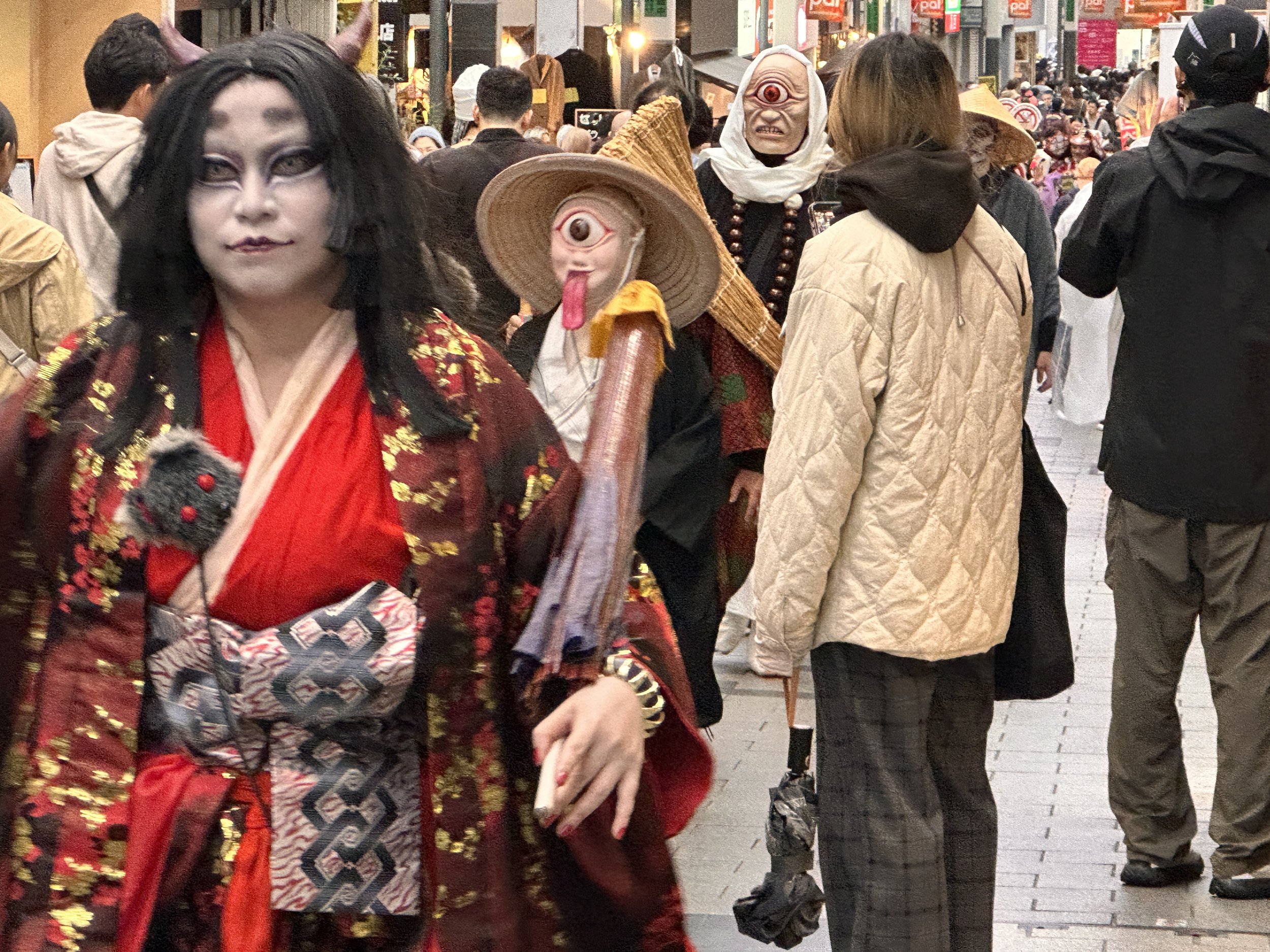
Koenji Fest Yokai parade of 1,000 demons.
Yokai are the diverse mythological creatures, objects, and spirits that have shaped and were used in many historical tales, famous kabuki plays, movies, and even in global crises such as the recent COVID19 epidemic. They include river creatures, snow women, shape-shifting animals, spiritual presence at night, and even daily objects with legs and human faces.
Yokai are not only fearful representations, they actually offer lots of ethical perspectives on the world and lessons for global citizens. Every society and culture historically grows and develops its own ways, stories, and explanations of danger, uncertainty, nature, human emotions, and the relationships humans have with their environment.
For visitors to Japan, yokai should not simply be Japanese monsters, symbols of folklore or figures of pop culture because Yokai are an invitation to look more carefully at the stories that shape places, beliefs,and better understanding of cultural differences that articulate societies' ways of living.
What is a Yokai ? Is a yokai a ghost?
There is not a unique answer nor explanation to what a Yokai is. The word yokai is often translated to foreigners as a “monster,” “spirit,” or “supernatural being,” but none of these translations is complete. Yokai can be frightening, protective, or comic. They are not meant to have one meaning but to open multiple perspectives.
The scholar Hirota Ryūhei describes them as mysterious phenomena or entities with an unusual ability to affect human life. They may be neutral, harmful, or good in their relationship with humans, which can change over time.
Some yokai are associated with landscapes: mountains, rivers, forests, coastlines, or snowy roads, while others appear in cities at night, at crossroads, or in places where people feel uncertain. Others are connected to familiar creatures, including foxes, raccoon dogs, snakes, and birds.
In Japanese folklore, yokai offer a creative way to approach what people cannot explain or control. Stories and art turn mysterious experiences into recognizable beings, sometimes frightening, sometimes mischievous or funny. Rather than simply defeating these creatures, people imagine ways to live alongside them, making the unknown feel more familiar through curiosity, humor, and imagination.Japan has regional traditions, and the same kind of beings may have different names, appearances, or stories depending on the area. Local yokai reflect local emotions, occupations, weather, terrain, and communal memory and hopes.
What is the history and origins of Yokai?
Yokai stories were developed through oral tradition, religious ideas, local legends, paintings, literature, and popular entertainment. They should not be presented as a simple branch of Shinto, but Shinto-related ideas about kami, places, and the spiritual significance of nature and objects. Stories changed as Japan changed.
One memorable type of yokai is the tsukumogami: a tool, object, or instrument that acquires agency after long use. In the medieval writing Tsukumogami ki, objects are said to receive souls after nearly one hundred years of service (Hirota,2021). Nowadays, the term is still being used more generally to describe objects that have served for a long time.
The appreciation for everyday objects also appears in Japanese shrines where objects can also receive a ritualized and sacred farewell rather than being thrown away. In Tokyo, Senso-ji holds the hari-kuyo, a ceremony honoring worn-out and broken sewing needles. Meiji Jingu hosts a doll appreciation ceremony to thank cherished dolls and their presence before parting with them. Shinozabu Bentendo in Ueno has a dedicated area for eyeglasses.
This does not mean Japan has one single environmental philosophy, or that every Japanese person believes objects have souls. Instead, yokai and shinto practices provide a cultural language for thinking about neglect, attachment, repair, and the hidden lives of everyday things.
As illustrated stories and woodblock printing became more popular and distributed, yokai started to become more recognizable too, with names, appearances, and personalities. Artist such as Katsuhika Hokusai brought further imagination to this supernatural world, with depictions of playful creatures and scenes from ghost stories.
One of the most famous Yokai works is known as Night Parade of 100 demons by Tosa Mitsunobu, which is a cultural property is housed at Shinju-an, a sub-temple at Daitokuji Temple in Kyōto. It features may different demons dancing in a parade like form and is the inspiration for modern Yokai festivals around Japan. Although, the temple and scroll work is rarely open for public viewing, many ukiyo-e museums around Japan will feature yokai art. Consider adding a visit to one of them to your trip.
Tokyo area ukiyo-e museums that may feature Yokai art (exhibitions and permanent collections are on rotation):
Kyoto area ukiyo-e museums that may feature Yokai art (exhibitions and permanent collections are on rotation):
What are Yokai’s functions for Japanese people?
Yokai stories often give a form to things people could not easily control: disease, dangerous weather, unfamiliar sounds, isolation, or the risks of travel. A river creature may warn against a hazardous current and a haunted object may dramatize anxiety about waste or abandonment. These stories show that emotions can become a form of shared knowledge. Communities tell stories to remember where danger and care lies, how to behave respectfully in a place.
Learning about yokai can make visitors more curious about the stories of other communities, rather than treating their own assumptions as universal. In Chofu, in western Tokyo, yokai become companions on an everyday stroll. Manga artist Shigeru Mizuki lived and worked here for many years, and his legacy appears in statues, signs, and souvenirs featuring characters from GeGeGe no Kitaro. Look out for Kitaro, his tiny father Medama-Oyaji, and the mischievous Nezumi Otoko as you explore—a playful way to discover how supernatural folklore found a new audience through manga
Amabie and the COVID-19 pandemic
Yokai are still present in contemporary Japan. During the COVID-19 pandemic, Amabie, a mermaid-like yokai, returned to public attention. The creature appeared in an 1846 broadsheet from Higo Province. (Furukawa and Kansaku, 2020)
In 2020, drawings of Amabie spread across social media. The figure appeared on posters, sweets, masks, and other items, while Japan’s Ministry of Health, Labour and Welfare used Amabie in public-health communication encouraging people to stay home and reduce infection risks. Amabie was a yokai figure that is historically linked to harvest and epidemics.
Of course, Amabie did not cure COVID-19 but its revival mattered because it gave people a shared image for anxiety, care, and solidarity. It is a powerful example of how old folklore and common knowledge can acquire a new role in a digital, global crisis.
Yokai in art and Popular culture
In the twentieth century, manga artist Shigeru Mizuki helped bring yokai to new audiences through GeGeGe no Kitaro. His work drew on regional folklore and transformed yokai into characters who could be funny, unsettling, sympathetic, or morally complex. Mizuki’s influence helped make yokai central to modern manga, animation, games, and tourism.
Yokai and ghost stories continue to shape Japanese popular culture, including contemporary horror cinema. One of the most influential examples is Tōkaidō Yotsuya Kaidan—often called Yotsuya Kaidan or The Ghost Story of Yotsuya—a kabuki tale first staged in Edo in 1825 by playwright Tsuruya Nanboku IV. Its central figure, Oiwa, becomes a vengeful ghost after betrayal and violence, and her story has been repeatedly adapted for theatre, film, and television.
A recent international example is The Face of Horror (2026), directed by Anna Biller. Premiering at the Toronto International Film Festival, the film adapts Yotsuya Kaidan into a fourteenth-century English setting, showing how Oiwa’s story of betrayal, violence, and ghostly revenge can travel far beyond Japan while retaining its emotional force.
Where can Yokai be found in the cities of Japan?
Tokyo’s supernatural stories are still woven in places you can visit today. In Yotsuya, Shinjuku, Oiwa Inari Shrine is associated with the spirit of Oiwa from the previously mentioned Kabuki play Yotsuya Kaidan. In northern Tokyo, Oji Inari Shrine is linked to the tales of the Kitsune, the majestic shapeshifting foxes. According to legends, foxes from the eastern region of Japan gathered on New Year’s Eve in Oji.
Usually known for the stores selling kitchenware, Kappabashi is home to Sogen-ji, also nicknamed “Kappadera”, the Kappa Temple. This temple and the streets of this neighborhood are punctuated by the statues and presence of the Kappa, a water dwelling yokai, believed to have helped flood prevention efforts.
In the close surroundings of central Tokyo, the Yakuo-in temple on Mount Takao, invites visitors and hikers to Tengu, a powerful yokai connected to religious practices and protection. The long nosed and bird beaked tengu are believed to be messengers of the gods. During the autumnal season, a walk on Mount Takao will give you the opportunity to enjoy the changing colors of the trees and to meet these Yokai connected to the spirit of the Mountain.
Tokyo is not the only place with temples related to Tengu and mountains. In Kyoto, on Mount Kurama, the temple Kurama-dera, is associated with a tengu that is said to have taught swordsmanship to the young Minamoto no Yoshitsune, an important historical figure of Japan.
For a more animated and central encounter with Yokai in Kyoto, the Yokai street located in the Taishogun shopping street area, transform your walk in the city into a playful treasure hunt for Yokai. If you pay attention, you can notice many handmade figures that represent various Yokai.
Are there any Yokai festivals or celebrations in Japan?
Beyond the inanimate yokai figure in the street of Kyoto, the Kyoto yokai festival at Toei Uzumasa brings yokai folklore to life. The festival is set among movie-studio streets where many costumed characters and performances happen and a reinactment of the parade of 100 creatures Ukiyo-e is conducted. Pay a visit to their website to know more about the specific activities on selected dates.
Tokyo also offers modern ways to encounter yokai culture, from museum exhibitions and bookshops to seasonal events. The Yokai Bon Odori (a community dance to honor ancestors) is a contemporary festival where visitors dress as yokai, dance, enjoy music and food stalls, and take part in a playful reimagining of the traditional Bon Odori festival. In 2026, the official festival was scheduled for October 10–12 at GREEN SPRINGS in Tachikawa, west Tokyo.
In addition to the Yokai Bon Odori festival in Tachikawa, a yearly parade, known as the Tokyo Hyakki Yakō (or 100 demons parade) 2026 took place on Saturday, October 24 as part of the Koenji Festival. Participants dress as yokai and parade through Koenji Look Shopping Street, turning traditional supernatural imagery into a playful community event. Each year anyone can participate in the parade for a small fee and a costume.
Are the Yokai in Nature too?
Some of Japan’s natural landscape might allow you to be closer to yokai and sacred nature than you think. For example, Wisteria offers a softer, whimsical, and almost fairy tale-like dimension of yokai. The cascading flowers are a symbol of protection, a delicate boundary between everyday life and unseen energies. From the yokai lens, walking beneath the wisteria blossoms becomes more than a seasonal experience, it is an invitation to pause and imagine the stories nature holds.
TokudAw’s article on the seasonal flower calendar in Japan and what to do during the Yokohama Green Expo in Japan highlights ways and places to enjoy wisteria for yourself. In Chiba, the Shimizu Park’s Hana Fantasia or the Koko-en beside Himeji castle, offer beautiful views of wisteria while also strolling among other flowers. Farther southwest, Kawachi Wisteria Garden is known for its immersive floral tunnel. TokudAw’s recommend you to always check the seasonal flower calendar, the flowering conditions and opening dates before visiting.
Yokai and the wider world
Becoming a citizen of the world does not mean treating all cultures as the same. It means recognizing that different communities make meaning in different ways, and being willing to learn before judging.
Yokai encourage that kind of attention. They connect local landscapes to local stories. They show how old beliefs can be adapted rather than simply preserved, and they remind us that fear, humor, illness, grief, and care are universal experiences expressed through different cultural forms.
TokudAw’s experiences can help visitors explore Japan through stories rather than stereotypes: why a region tells certain tales, what a creature may reveal about daily life, and how folklore travels in traditions, art, and contemporary society. TokudAw approaches travel in Japan as a way to connect places with meaning. Rather than simply moving between famous destinations, we create journeys that help visitors understand the stories, people, and cultural traditions behind what they see and experience.
FAQ
Are there haunted houses to visit in Japan?
Although Yokai are spirits, the haunted house attractions in Japan usually do not directly feature Yokai. However, the House of Monsters in Noboribetsu in Hokkaido does feature Yokai. Japan has several pure-haunted house attractions including one of the largest haunted houses in an abandoned hospital in Yamanashi prefecture at the theme park Fuji-Q Highland.
Can I visit various yokai spots in one day?
You can combine a selection of Tokyo’s spots in one day, rather than trying to see them all. TokudAw can help plan a comfortable route, with a private car to optimize your tour. For a spookier atmosphere, include an evening stroll, while checking opening hours and respecting temple and shrine grounds.
Does TokudAw offer yokai tours?
Yes. TokudAw can arrange a personalized itinerary and guide service to introduce you to Japan’s yokai stories, from mischievous creatures to local ghost legends.
Where can I find yokai souvenirs?
Chofu is a lovely place to start. Visit Kitaro Chaya on Tenjin-dori near Chofu Station for GeGeGe no Kitaro gifts, character goods, and themed treats inspired by Shigeru Mizuki’s world of yokai.
Are yokai related to Halloween?
In the modern era, Japan celebrates Halloween, but this is a new practice. The yokai folklore has been long-established before Halloween was celebrated by Japanese people. However, many (not all) of the yokai events in Japan happen in the weeks before Halloween.